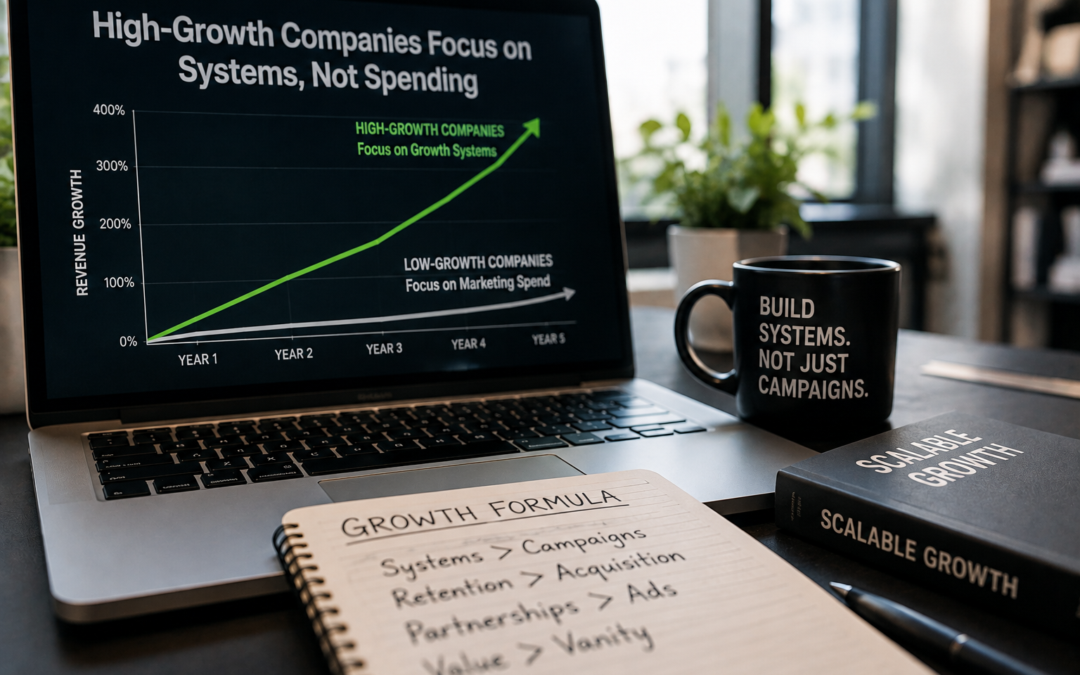
Most executives assume the fastest-growing companies outspend everyone else on marketing.
It is an intuitive belief. Growth is visible. Marketing is visible. It is easy to assume one causes the other.
Yet the world’s most enduring growth stories tell a different story.
The companies that consistently outperform rarely win because they buy more attention. They win because they build businesses where every future customer becomes easier, cheaper, and faster to acquire than the last.
That is the real competitive advantage.
Marketing creates attention. Growth systems create momentum.
Attention can be purchased.
Momentum must be designed.
The difference separates companies that experience bursts of growth from those that sustain it for decades.
The Marketing Illusion
When growth slows, the instinctive response is almost always the same.
Increase the marketing budget.
Launch another campaign.
Expand paid acquisition.
Optimize conversion rates.
These actions are sensible. They are also temporary.
Marketing is exceptionally good at accelerating demand. It is far less effective at creating the conditions that make demand increasingly efficient.
Eventually every marketing channel becomes more expensive. Competition increases. Audiences become saturated. Customer acquisition costs rise. Each additional customer requires greater investment than the one before.
The problem is not marketing.
The problem is expecting marketing to solve what is fundamentally a systems design challenge.
The Growth Architecture
The fastest-growing companies build what can be called Growth Architecture.
Growth Architecture is the collection of strategic assets that make every future marketing investment more productive than the previous one.
Unlike campaigns, these assets continue creating value long after they are built.
Five strategic multipliers form the foundation.
Product Excellence gives customers a reason to stay.
Customer Advocacy turns satisfied customers into trusted acquisition channels.
Strategic Partnerships provide immediate access to audiences, credibility, and capabilities that would otherwise take years to develop.
Distribution Advantage ensures customers can discover and adopt the product through multiple efficient pathways.
Network Effects increase the value of the business as participation grows.
The power of Growth Architecture is not found in these assets individually.
It is found in how they reinforce one another.
Better products create stronger advocacy.
Advocacy attracts better partners.
Partners expand distribution.
Distribution strengthens network effects.
Network effects improve the product experience.
Every improvement makes every future marketing dollar more productive.
Growth is no longer additive.
It becomes compounding.
The Economics of Compounding Growth
Most companies measure growth by asking a simple question:
How many customers did we acquire?
High-growth companies ask a better one:
Did we make the next customer easier to acquire than the last?
That distinction changes investment decisions.
A successful referral program lowers future acquisition costs.
A trusted partner transfers credibility before the first sales conversation.
A developer ecosystem creates value the company never had to build itself.
A loyal customer community educates prospects before the sales team becomes involved.
Each investment improves the economics of every investment that follows.
Marketing scales attention.
Growth systems scale economics.
The objective of growth strategy is not simply to acquire more customers.
It is to reduce the cost of acquiring every future customer.
What Category Leaders Actually Built
Apple did not build a collection of products. It built an ecosystem. Every additional device increases the value of the others, strengthens customer loyalty, and raises switching costs. Existing customers become the most efficient source of future revenue.
Amazon designed reinforcing loops rather than isolated initiatives. Prime increased purchasing frequency. Higher demand attracted more sellers. More sellers expanded selection. Better selection improved customer experience, which attracted even more Prime members. Each loop strengthened the next.
Salesforce expanded through an ecosystem of implementation partners, developers, consultants, and software providers. Thousands of external organizations became extensions of its growth strategy, expanding adoption far beyond what marketing alone could achieve.
Visa built one of the most powerful network effects in business. Every new cardholder increased value for merchants, and every new merchant increased value for consumers. The network itself became the primary engine of future growth.
Different industries.
Different business models.
The same strategic principle.
Each company invested in assets that continuously reduced the cost of future growth.
Why Many Companies Stay Stuck
Many organizations optimize campaigns instead of designing systems.
Marketing generates leads.
Sales closes deals.
Customer success retains customers.
Business development manages partnerships.
Product builds features.
Each department performs well individually.
But sustainable growth is not created by functional excellence alone.
It emerges when every function strengthens the others.
Organizations often improve marketing performance without improving growth because they optimize the accelerator while neglecting the engine.
That is a strategic failure, not a marketing one.
An Executive Growth Audit
Before approving the next increase in marketing spend, leadership teams should ask six questions.
- What percentage of our growth depends entirely on paid acquisition?
- Which organizations already have trusted relationships with our ideal customers?
- Which assets reduce customer acquisition costs every year?
- Which assets become more valuable as more customers join?
- If advertising stopped tomorrow, what would continue generating demand?
- What are we building today that will make every future marketing dollar work harder?
The answers reveal whether growth is being rented or built.
The Mindset Shift
There are two fundamentally different approaches to growth.
The first asks:
“How can we spend more to acquire customers?”
The second asks:
“How can we build a business that requires less effort to acquire each additional customer?”
One increases marketing budgets.
The other increases enterprise value.
The strongest companies understand that marketing is essential, but it performs best when supported by assets that compound over time.
Products customers recommend.
Partners that expand distribution.
Communities that create trust.
Ecosystems that deepen loyalty.
Networks that become stronger with every participant.
These are not marketing tactics.
They are strategic assets.
The Real Secret Behind High-Growth Companies
Companies rarely become category leaders because they spend the most to generate demand.
They become category leaders because they design businesses where every satisfied customer, every strategic partnership, every product improvement, and every new participant makes the next stage of growth easier than the last.
That is why sustainable growth compounds while paid growth often scales linearly.
Marketing can buy today’s attention.
Growth Architecture lowers tomorrow’s cost of earning it.
That is the difference between accelerating growth and engineering it.

Brimbravo is a selective representation firm that connects attention, access, and strategic placement for individuals and brands capable of sustaining scale. We purposefully limit our engagements.