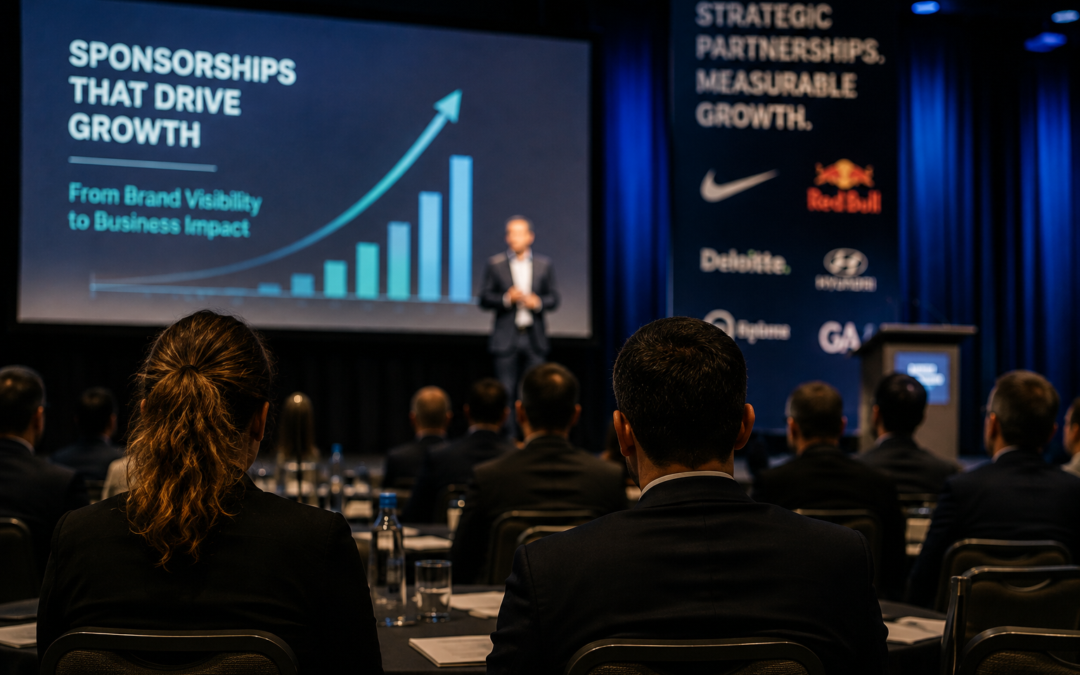
Every year, organizations invest billions in sponsorships while asking a question that has surprisingly little to do with business growth:
How many people saw our logo?
The highest-performing companies ask a different question entirely:
What business becomes possible because of this sponsorship?
That single shift represents one of the most important changes occurring in commercial strategy.
As customer acquisition becomes more expensive, trust becomes more difficult to earn, and competitive advantage increasingly depends on ecosystems rather than individual capabilities, sponsorship is evolving from a marketing activity into commercial infrastructure.
The organizations creating the strongest returns are not buying exposure.
They are building systems that continuously create customers, partnerships, market access, distribution, innovation, and recurring revenue.
Average companies buy visibility.
High-performing companies build commercial leverage.
The Wrong Question Produces the Wrong Return
For decades, sponsorship has been evaluated using marketing metrics.
How many impressions did we generate?
How much media coverage did we receive?
How many people recognised our brand?
How much hospitality did we provide?
These questions measure activity.
They rarely explain commercial performance.
A logo does not generate revenue.
A relationship does.
An impression does not reduce customer acquisition costs.
Trust does.
Visibility has value only when it changes commercial behaviour. If greater awareness does not create stronger customer relationships, qualified opportunities, strategic partnerships, or new routes to market, it remains a communications outcome rather than a commercial one.
High-performing organizations therefore ask fundamentally different questions.
Which customers will this sponsorship help us acquire?
Which executive relationships will it create?
Which trusted institutions will transfer credibility to our business?
Which partners could become future distributors?
What commercial assets will still exist after the event has ended?
Those questions move sponsorship from the marketing budget to the boardroom.
Sponsorship Reduces Commercial Friction
Every commercial transaction contains friction.
Buyers hesitate because they face uncertainty. Before making meaningful purchasing decisions, they assess credibility, capability, reputation, and risk.
Reducing that uncertainty is one of the most valuable activities any organization can perform.
When friction decreases, sales cycles shorten.
Conversion rates improve.
Customer acquisition costs decline.
Market entry accelerates.
Exceptional sponsorship achieves exactly this.
Association with respected sporting organisations, industry associations, universities, charities, cultural institutions, or globally recognised brands transfers trust before the first commercial conversation even begins.
Prospects arrive with greater confidence.
Conversations become easier.
Business moves faster.
Viewed through this lens, sponsorship is not simply generating awareness.
It is reducing the economic cost of growth.
Sponsorship Capital
The most sophisticated organizations create something that traditional sponsorship measurement rarely recognises.
They build Sponsorship Capital.
Sponsorship Capital is the accumulated commercial value created through trusted relationships, privileged market access, strategic partnerships, executive credibility, and expanded distribution.
Like financial capital, Sponsorship Capital compounds.
Every trusted introduction increases the probability of future introductions.
Every successful partnership attracts stronger partners.
Every commercial success improves credibility for the next opportunity.
Unlike media impressions, Sponsorship Capital does not disappear when an event finishes.
It becomes an appreciating strategic asset.
Sponsorship as Commercial Infrastructure
The strongest organizations no longer isolate sponsorship inside marketing.
They integrate it across the entire commercial system.
Sales teams use sponsorship to secure executive introductions that cold outreach rarely achieves.
Business development teams identify alliance opportunities within sponsored ecosystems.
Customer success teams deepen retention through exclusive experiences.
Executive leaders strengthen relationships with decision-makers in environments built on trust rather than transactions.
Product teams identify innovation partners and gather market intelligence.
The result is not a better marketing campaign.
It is a stronger commercial system.
One investment creates multiple strategic outcomes simultaneously.
That is leverage.
The Revenue Engine Framework
World-class sponsorships consistently create five reinforcing commercial assets.
Access
Access comes first because no commercial opportunity exists without proximity to customers, decision-makers, industries, or influential communities.
Trust
Access alone rarely converts into opportunity. Trusted associations reduce perceived risk and increase willingness to engage.
Relationships
Trust creates meaningful conversations that develop into referrals, executive relationships, partnerships, and long-term collaboration.
Distribution
Strong relationships open new routes to market through partners, suppliers, affiliates, members, complementary businesses, and strategic alliances.
Revenue
Revenue comes last because sustainable commercial growth is the outcome of the previous four assets working together. Organizations attempting to monetise before building access, trust, relationships, and distribution rarely create durable competitive advantage.
This framework is cumulative rather than linear.
Each asset increases the productivity of the next.
More access creates more trust.
More trust creates stronger relationships.
Stronger relationships expand distribution.
Broader distribution creates more customers.
More customers strengthen reputation.
A stronger reputation attracts better sponsorship opportunities.
Every successful cycle increases the value of the next.
Why Revenue Engines Compound
Traditional sponsorship follows a linear model.
Investment → Exposure → Awareness
Once attention fades, much of the value disappears.
High-performing organizations build reinforcing feedback loops instead.
Sponsorship → Trust → Relationships → Distribution → Customers → Reputation → Better Sponsorship Opportunities
Unlike linear campaigns, reinforcing systems become stronger through repeated use.
Every customer creates referrals.
Every referral strengthens reputation.
A stronger reputation attracts higher-quality partners.
Better partners expand distribution.
Expanded distribution generates more customers.
The system becomes progressively more productive because each output strengthens future inputs.
This is why the best sponsorship strategies do not simply produce returns.
They improve the economics of future growth.
Visibility fades.
Relationships compound.
Exposure creates awareness.
Ecosystems create revenue.
The highest return from sponsorship often begins after the event concludes.
What Market Leaders Actually Build
Red Bull is often described as a prolific sponsor of extreme sports.
In reality, it built an ecosystem.
Athletes, owned events, media production, digital publishing, retail activation, and global partnerships reinforce one another, transforming sponsorship into proprietary commercial infrastructure rather than rented attention.
American Express uses sponsorship to increase customer lifetime value rather than simply maximise awareness. Exclusive experiences, privileged access, and strategic partnerships strengthen loyalty while making membership increasingly valuable over time.
Salesforce designs sponsorship around ecosystem expansion. Customers, developers, consultants, technology partners, and investors create value for one another, making every new relationship increase the productivity of the platform itself.
Formula 1’s leading commercial partners invest for executive access, technology collaboration, customer relationships, hospitality, innovation, and international market entry. Trackside branding is merely the visible expression of a much larger commercial system.
Different industries.
One strategy.
They are not buying sponsorships.
They are building ecosystems.
Why Many Sponsorships Underperform
Most sponsorship failures are not activation failures.
They are design failures.
Organizations continue treating sponsorship as advertising instead of commercial infrastructure.
They optimise impressions instead of executive introductions.
They celebrate reach instead of qualified customer conversations.
Marketing owns the investment while sales, partnerships, customer success, and leadership remain disconnected from it.
The sponsorship ends when the event ends.
The commercial opportunity disappears because no enduring assets were intentionally created.
The sponsorship performed exactly as designed.
The design was simply too narrow.
An Executive Sponsorship Audit
Before approving any sponsorship investment, executives should ask:
- Would this sponsorship still create value if nobody saw our logo?
- Which strategic relationships will it create?
- Which customers become easier to acquire because of this partnership?
- Which distribution channels could emerge?
- How will sales, partnerships, and customer success activate this investment together?
- Will this lower customer acquisition costs, increase customer lifetime value, or improve the productivity of our commercial relationships?
- What commercial assets will still exist one year after the sponsorship ends?
- Are we buying exposure or building Sponsorship Capital?
The answers reveal whether sponsorship is functioning as a recurring asset or a recurring expense.
The Executive Mindset Shift
Traditional sponsorship thinking says:
“We need more visibility.”
“We need more impressions.”
“We need more awareness.”
Revenue-engine thinking says:
“We need stronger customer relationships.”
“We need trusted market access.”
“We need strategic partnerships.”
“We need commercial leverage.”
“We need sponsorships that continue generating value long after the event.”
This is not simply a change in language.
It is a change in economics.
Few executive investments can simultaneously reduce customer acquisition costs, increase trust, expand distribution, strengthen strategic partnerships, improve customer lifetime value, and create recurring revenue.
The best sponsorships accomplish all of these at once.
The Future Belongs to Commercial Ecosystems
Markets reward organizations that accumulate durable assets.
Factories were once strategic assets.
Then software became a strategic asset.
Today, trusted commercial ecosystems are becoming strategic assets.
The next generation of market leaders will not win because they sponsor the most events or negotiate the largest branding packages.
They will win because every sponsorship strengthens a system that continuously creates customers, trusted relationships, strategic partnerships, broader distribution, and recurring revenue.
Companies that measure sponsorship by visibility will continue renting attention.
Companies that build Sponsorship Capital will own relationships, market access, and commercial ecosystems that competitors cannot easily replicate.
The most valuable sponsorship is not the one that gets your brand seen. It is the one that makes your business more trusted, more connected, and more valuable long after the applause ends.
Brimbravo is a selective representation firm that connects attention, access, and strategic placement for individuals and brands capable of sustaining scale. We purposefully limit our engagements.